Showing posts with label nancy holt. Show all posts

Wednesday, December 1, 2010

Nancy Holt's Burial Project Part 3


Obviously I've been thinking a lot about Holt's Burial Project lately (and mapping projects in general) due to dedicating three posts to it. Elise and I laughed about it last week in terms of how we keep seeing it referred to in various publications but it's essentially the same 3-4 sentences paraphrased differently. I did find this new addition from The Map as Art: Contemporary Artists Explore Cartography which will merit another post in the not so far future. In addition to maps and photographs of the locales, Holt also included booklets. They "presented a series of maps, beginning with an overall map of the United States, zooming in on the poem's locations, indicated with a dot. The gesture of a personalized poem at the project's heart and the 'lived body' mapping that occurs via the trek to and from the poem make it obvious that this is meant to be a one-of-a-kind experience. The booklets with maps both enable, and are souvenirs of, the individual journeys Holt 'gave' to her friends."

Here is a photograph of one of the booklets - a crude representation contrasted with the one above (which is incidentally, the only map I ever find associated with this project).

Sunday, November 21, 2010

More on Nancy Holt's "Buried Poems" & Jan Estep's "Beneath the Surface of Language"

Elise found more information on the Buried Poems from this dated website:

"LOCATION: places such as an unnamed, uninhabited island in the Florida Keys, Arches National Monument Desert in Utah, and at the bottom of the Highlands of Navesink near Sandy Hook, New Jersey.

"Holt gave five people (Michael Heizer, Philip Leider, Carl Andre, John Perrault, and Robert Smithson) a packet of information which allowed them to find and dig up a poem. Each poem was buried in a location which was chosen based on their personality. Included in the packet were such items as maps, photos, very detailed directions for finding the poem, along with either postcards, cut out images, and maybe specimens of leaves or rocks from the site. The recipient would eventually understand his connection with the site. The poems were all buried in vacuum containers which would last long enough for them to dig it up whenever they happened to be near the area."

Of course I would like to know if any of these people ever found their poems - the idea of them sealed in vacuum containers is intriguing though anti-ephemeral just like the vast majority of American Land Art.

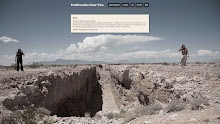
My search for more information brought me to Jan Estep's Beneath the Surface of Language. Estep spent two weeks at the Center for Land Use Interpretation residency program to create "a site-specific map/text/photo project featuring the 54-mile backcountry Silver Island Mountain Byway, a BLM-managed route near the Bonneville Speedway just outside of Wendover, Utah."

She comments on Nancy Holt's Buried Poems and John Baldessari's California Map Project - two of my favorite works in the genre of art and mapmaking.


See more of Estep's work here. Image above from Estep's Site #2.

Sunday, October 24, 2010

Nancy Holt's Burial Project


Nancy Holt, The Last Map Used to Locate Buried Poem Number 4 for Michael Heizer, 1969-71


Nancy Holt, Buried Poem Number 4 for Michael Heizer The Double O, 1971 & Buried Poem Number 4 for Michael Heizer, Dark Angel through Double O Arch, 1971

From Phaidon's Land and Environmental Art:

"These poems were private artworks. Holt dedicated the poems to five different people (Michael Heizer, Philip Leider, Carl Andre, John Perrault, and Robert Smithson) and chose the remote sites according to certain physical, spatial, and atmospheric qualities which would evoke a particular person for her. The poems were buried in vacuum containers, and the recipient received a map which contained all the necessary information for the poem to be found and dug up. The map provided Holt with both a physical location and characteristics which she could relate to a specific person, as well as a symbolic space in which to construct the meaning presented in the poems. Along with the instructions on how to find the site she included details of the history, geology, flora, and fauna of the site as well as maps, pictures, and specimens of rocks and leaves."

I have been thinking a lot about Holt's Burial/Mapping project recently as a way to incorporate artist correspondence with interring objects. We are working hard researching the second leg of our journey and I of course, want to continue exploring the object in remote locales. I am not interested in writing poems or cataloging the flora and fauna of the environment but I AM intrigued by responding to something within that place and referring it to the artists who I will send a letter to. The artists will be ones inspirational to our project yet there will be no response anticipated.

Wednesday, June 24, 2009

A couple things about Sun Tunnels


Nancy and I arrived in Wendover, Utah in the late afternoon after spending significant time at the Bonneville Salt Flats. We jumped into the freezing hotel pool, ate an overpriced buffet at the Rainbow (note to self: buffet dinners at casinos are a waste of money for vegetarians), and drove rather quickly to Lucin, Utah as we were trying to arrive well before the setting sun. We encountered a very large puddle of water that Nancy promptly donned her moustache and Michael Heizer jacket to ford because "this is a man's job" and John Ott's "use common sense" was ringing in our ears. Fortunately it wasn't as deep as it looked (but the rental car suggested otherwise = whoops!).

I have had this vision of seeing how close we could drive to an earthwork since we started this trip and that was solved rather quickly upon our arrival - Sun Tunnels was the ideal candidate. Afterward, what we quickly found was disturbing. Someone within the last 24 hours had driven through the middle of the artwork and got stuck. Their solution was to use all of their car mats in an effort to provide traction to escape the deep pit they were quickly making in the soft earth. We are not sure how they escaped but they left all of their mats inside one of the tunnels, enough tire gouges to provide a distraction, and someone wrote in the mud in between the absent wheel base "Fuck Your Karma." HIGHLY ANNOYING.

The sun was quickly falling and we were frantically running around trying to photograph a burial and the general vicinity before stationing ourselves in the tunnels to see the setting sun. We were very happy that the sun did indeed fall in nearly the same location as it would have on the solstice two days earlier.

I set to work on a collection box and Nancy began filling the tire gouges in a performance of endurance - positioning dirt, removing the text written in the mud, and "cleaning up" the area to the best of her ability. About 20 minutes later, fatigued, she stopped. Unfortunately we didn't have large shovels to smooth over the rest of the earth.

We stayed well into the evening, catching a sliver of a moon setting in the western night sky and a planet we guessed was Venus (but that was just an assumption). There were a couple sound recordings - screams and whistle blowing. I tried very hard to deposit the rock I brought from Spiral Jetty on top of one of the concrete tubes but failed each time I tossed it over to hear it roll off the other side. In frustration, I hurled it into the middle of the tubes announcing, "It is now here" as soon as it fell. I don't know what compelled me to bring a piece of Robert Smithson to Nancy Holt - it resides in the mud that Nancy D. tried to fill and as a result, I brought a cracked, dried portion to bring to Double Negative - carrying a piece of one to the next. I will figure out where this is going but for now, I don't have an answer.

Seeing Sun Tunnels at the time it was meant to be viewed changed everything for me. Sitting down at the edge of the most westerly tube, catching my breath, and watching the sun dip below the horizon was an eye opener. Wishing we had more time to spend before night fell is my only regret.

We stopped along the road outside Montello, Nevada to stare at the Milky Way lying on the shoulder of the road watching a satellite fly overhead. I had not seen such a clear night sky with relatively little light pollution in years. I will take back the memory of the stars with me - though we did not see them inside Nancy Holt's tubes, we were able to experience the sunset and that was all that I needed to qualify visit this as a success.

Wednesday, May 27, 2009

25 Days to Go: Nancy Holt's "Sun Tunnels" (Four Concrete Tubes Followed by a Plastic One)


Hey guess what Nancy? We are going to be visiting Sun Tunnels two days after the Summer Soltice. Do you think the artwork will still be close enough to align with the sun? We should aim for late afternoon/early evening just in case.

Here are the directions on how to get there (though I think I will remember this one well enough).

I will look forward to discussing what you think of this piece as I cannot help but feel it is the most inferior of the group. I am hoping my second trip proves me wrong especially if we see it close to the time of year and day that it is supposed to be viewed. I do like the idea of "tricksters" visiting these earthworks and simulating the sun via car headlights, etc. if the sun's alignment does not work to our advantage.

After spending a couple hours on the phone tonight discussing hotels and the budget for this three week extravaganza, I continue to be excited about this tube at the Golden Nugget in Las Vegas:


(Image courtesy of Five Hundy).

The "Uniform" - What Smithson, Holt, Heizer, & Turrell Wore When Creating These Works

Finding what Robert Smithson wore was really easy. He doesn't look like he belongs in this space at all. There are two outfits (what do you think about combining them both or one take the role of the waiters and the other the black "I'm a NY artist" look?).


Smithson with Richard Serra, 1970


Smithson and the Construction of Spiral Jetty, 1970


Smithson and his waiters (I call, "Not It" on wearing this one)


I cannot find anything (as of yet) on what Nancy Holt wore. I surmise that this is her in the views of Sun Tunnels but cannot be certain. Whatever she is wearing, she is NOT trying to be a cowgirl or cowboy for that matter.

This is the Nancy Holt we will not be emulating:


Heizer is also easy to find. Here he is with Robert Smithson in Nevada in 1968 (I am counting on finding a white cowboy hat). Here's a more recent headshot.


And James Turrell... Oh! The black cowboy ensemble! Maybe you can buy the white gear and I'll buy the black and we'll really be covering a lot of territory.


What is so odd is that I really want them to be wearing something like in Richard Prince's Untitled Cowboys photograph from 2003. Dream on.


Of course we can always dump the whole idea and go looking like this:

Sunday, February 1, 2009

Western Washington University, Bellingham, WA July 2008

Expectation vs. Reality


When I first learned about earthworks in Cheryl Shurtleff's Contemporary Art History summer crash course, I remember her referring to Western Washington University in Bellingham. It was known for commissioning earthworks artists to create pieces for the campus that were smaller scale representations of what they would "show" in remote places (at least in the case of Nancy Holt). My friend Cass and I traveled there in July 2008 and what we found was ultimately disappointing. A new building under construction left the Nauman and Holt pieces inaccessible (two of the top three I wanted to see). The above photographs show the closest I could get without trespassing (not that that's been an issue in the past - ahem).

I most wanted to see Robert Morris's Untitled (Steam Work for Bellingham) but it was far too warm a day for that. Wishing I could see the artworks as they were depicted in the Sculpture Collection guide (as viewed above) became the common theme.

I'm always interested in viewing Richard Serra's site specific sculptures including the early, far less monumental works like the one of Anita Powell featured below at Kentuck Knob in Chalk Hill, Pennsylvania. Blatantly touching them is not something I normally do but when they are presented outdoors in a public setting, knowing full well that a myriad of other people leave their oils and graffiti all over them, manhandling them became irresistible.