I am spending the afternoon researching Michael Heizer's
Double Negative. The most important information I've found is how to get
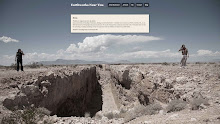
there!By descending steep ramps at the ends of the trenches, visitors can enter a long, narrow lane that reveals a view across the ravine to the trench on the opposite side. Heizer stipulates that we should spent one whole day with the sculpture in order to understand it: to grasp its size, surfaces, spatial structure, and transformation in light and shadow. Bring lots of water and snake repellent. It's going to be the trip's #1 scorcher.

Construction of the SW cut from the NE Cut, December 1969
Michael Heizer: "It is interesting to build a sculpture that attempts to create an atmosphere of awe. Small works are said to do this but it is not my experience. Immense, architecturally sized sculpture creates both the object and the atmosphere. Awe is a state of mind equivalent to a religious experience. I think if people feel commitment they feel something has been transcended. To create a transcendent work of art means to go past everything."

Construction of the SW cut from the NE Cut, December 1969 (2 weeks later)
From an essay entitled “Rend(er)ing” by Mark C. Taylor:
Edmond Jabès once stated: “You do not go into the desert to find identity but to lose it, to lose your personality, to become anonymous. You make yourself the void. You become silence. It is very hard to live with silence. The real silence is death and this is terrible. It is very hard in the desert. You must become more silent than the silence around you. And then something extraordinary happens: you hear silence speak.”

Looking toward the SW Cut, 1970
Mark C. Taylor: “To reach
Double Negative, it is necessary to go past everything. The drive from Las Vegas to Overton passes through 80 miles of desert. The mineral landscape appears more stark and cruel from the road than from the air. This desert is unforgiving. The height of Mormon Mesa looms larger when driving up the twisting and turning red dirt road that leads to its top. From ground level, the barrenness of the earth’s surface is violated not only by scrub sage but also by tracks of errant vehicles. Even a person who knows his way gets lost in this terrain. We roamed for a long time but could not find
Double Negative…. With darkness approaching, our search became more agitated. We drove ever closer to the mesa’s precipitous edge. At every turn, the cut seemed to appear. But as we drew near, the illusion of the cut’s presence was broken and the mirage lifted. Turning the truck around to make a final sweep, the cut or cuts unexpectedly opened in front of us.”

Looking toward the SW Cut, 1986
“To enter the tear, I had to descend the steep and uneven slope of the rent earth. Only beneath ground level did the stunning proportions of this extraordinary work clearly emerge…. From the bottom of the cut, the precision of the lines, surfaces, and planes dissolves. The work is eroding. It’s walls crumbling and its floor littered with refuse and debris from ancient eons, the Negative is a constantly changing ruin. This work of art was not constructed to escape time but to embed us in it ever more deeply. As I passed below the surface, I realized the profound truth of what I had long suspected: to dig down is go back… back through layers and layers of space and time to an
arche that is, perhaps, “older” than the beginning of our world, the world, any world.”

Inside Walls of the NE Cut, 1969
“With night drawing near, I lingered in the
Negative. I picked up a fragment from the debris in the midst of the tear. It was a remarkable object or assemblage of objects. Ancient, yet fragile, terribly fragile. Its shape, almost pyramidal; its size no bigger than the palm of my hand; its colors multiple. Pink, rose, brown, amber, umber, lavender, rust, red, yellow, orange, black, white, and charcoal – pebbles and crystals held together by sand strong enough to withstand the shifting winds of time and weak enough to crumble when touched. It would be hard to imagine a more intricate or more successful work of art.”

East Wall of the SW Cut, 1970
“Lost in reflection, the silence that surrounded me was suddenly shattered. At first, I thought a violent desert storm had erupted. The walls of the rift shook. Sand, stones, and gravel slid to the bottom of the
Negative and beyond to the canyon far below. Startled, I turned toward the distant mountains. Framed by the trembling walls of
Double Negative, I caught a fleeting glimpse of two fighter bombers in mock combat, disappearing over the horizon. As the deafening noise of the planes waned, Heizer’s words echoed in my ears. ‘We live in a schizophrenic period. We’re living in a world that’s technological and primordial simultaneously. I guess the idea is to make art that reflects this premise.’”

Two views of
Double Negative from 2007