Showing posts with label robert morris. Show all posts

Monday, August 16, 2010

Jen Graves: "When Art Becomes a Dog Park"


Jen Graves's article in the Stranger discusses the changing nature of Robert Morris's Untitled (Reclamation Project). This earthwork has always had a special place in my heart since Nancy and I first visited it in 2007 and decided we would travel to as many earthworks as we could the following summer.

Some highlights from the article:

"The artist's defiant words are etched into the informational plaque at the entrance to Johnson Pit #30; the plaque also describes the site as "remote" and "contemplative." That was true in 1979. But Johnson Pit #30 now sits awkwardly between teeming, winding colonies of townhomes, all built within the last 10 years (some within the last three years, still containing their pioneer residents) and bearing names that refer to the river valley below and its mountain views: The Heights at Ridgeview, Creekside New Homes, Valley View Condominiums, River Ridge Community, Viewcrest Condos. "Total Privacy in Every Room!" is the advertisement for one unit for sale for $229,000. Seen from the top of the pit, these tightly ordered, monochromatic complexes—each with a row of flags at its entrance, like a little nation—look like toy neighborhoods. In the distance, past all the gleaming new pavement, there's one lone red barn left."

"Interviews with a dozen of Johnson Pit #30's neighbors who answered their doors or were caught walking to and from their cars revealed that the art is used mainly as a dog park and outdoor gym. Some owners park cars at the top and stay inside while releasing their dogs down into the pit to tire themselves out; the paths of the hilly slopes are perfect for workouts. The goats who come to clean up the blackberry brambles every year—brought in by the county arts agency that still owns and maintains the sculpture, 4Culture—make the biggest impression, not the sculpture itself, whose form is seen as either pleasant or odd or overlooked entirely. Few people had noticed the rows of tree stumps, and nobody knew what they were supposed to mean; nobody had read Morris's fighting words on the plaque."

In many ways Graves's experience with Morris's work echoes what I witnessed at Robert Smithson's Spiral Hill and Broken Circle: an audience that interacted with the artwork on another level discounting the artist's original intentions. That is one of the things that most interests me about these earthworks - the sociological context they now reside in. It brings a brand new meaning to audience participation most heavily influenced by the element of passing time.

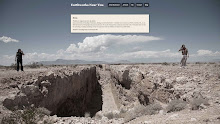
Here is Morris's work photographed in 1979:

Sunday, June 7, 2009

Two weeks from today...

...we'll be in a motel room in Brigham City, Utah working on this blog and figuring out how I am going to wake up "early" the following morning. I keep thinking about the line underneath our photograph on the sidebar of this blog: "Journey Started June 08." Last year after venturing through Indiana, Illinois, Wisconsin, Minnesota, North Dakota, Montana, Wyoming, Idaho, and Oregon we ended up in Kent, Washington at Robert Morris's Untitled Reclamation Project. I wanted to see it for several reasons. A few years earlier in 2004, my ex-husband and I had plans of visiting as many earthworks as we were able and to publish a book about it. We started in The Netherlands with Robert Smithson's Spiral Hill and Broken Circle. The following year we saw Spiral Jetty and Sun Tunnels. That plan never materialized but the desire persisted.


I wanted to visit Morris's artwork to see if I was still able to carry on with this project on my own. Fortunately, Nancy was as interested as I was and we forged a new plan to create our own projects and collaborate on a journey that would take place in 2009. Last summer we also saw Herbert Bayer's Mill Creek Canyon Earthworks (also in Kent, Washington) with my cousin Donna and my friend and artist Maggie Smith.


Maya Lin's Confluence Project was also on the route. That trip was a precursor to everything that is happening now. Part of it was published in the Spring 2009 Issue of Art Lies. If this blog has offered me one thing before we share it with the world, it has been a most useful forum to hash hair brain ideas out with you, Nancy, and watch them materialize into something possible. Here's to following through. Here's to PBJs and Cake Icing Wars. Here's to going where several people have gone before but in an entirely new way.


"14 June 2008: Robert Morris’s Untitled Reclamation Project, Kent, Washington

Day 17 of the same road trip. Seeing every major earthwork in the American West (and the lesser known ones if they are not out of the way) is #7 on the “before I die” list. I am drawn to the photographs of land art taken just after they were made. The grass hasn’t grown over the freshly formed dirt and they are not enveloped by their surroundings. The differences between contemporary perspectives and the photographs taken four decades earlier are profound.

Robert Morris’s Untitled Reclamation Project is no exception. In 1979, Morris was hired by King County Arts Commission to transform the former Johnston Pit #30 into an artwork from land abused from mining gravel. Today, the suburbs encroach in the distance, the space between them compressed like the perspective in a medieval painting.

Nancy and I followed the desire lines to the center of the sloping form where we picked rye grass and yellow flowers to press in wax paper. I videotaped her running from the bottom of the depression up but only the first two seconds recorded. We stood on opposite sides, dark specks in the landscape, marveling at the city around us, and how little the sounds of traffic were heard.

Every few years goats are rented for a week from nearby Vashon Island to eat the blackberry brambles that slowly cover the earthwork. The houses in the distance become closer, and bring more traffic. Nothing is being done to eliminate halt their invading presence."

Saturday, June 6, 2009

Wrong vs. Right

Wrong but fascinating:
Curiosa by Barton Lidice Benes:

From Publishers Weekly
A born collector-"I have always been afraid of losing things"-Benes leaves no gallstone (see page 59 for Larry Hagman's) unturned in his acquisition of odd objets. The artist's fastidious catalogue recalls crime-scene investigations and Albertus Seba's Cabinet of Natural Curiosities. Whereas the 19th-century pharmacist recorded rare flora and fauna, Benes preserves the leavings of celebrity culture-Nancy Reagan's chocolate-souffle‚ stained napkin, Bill Clinton's half-sucked throat lozenge, Roy Rogers's nasal douche. Macabre, witty and earnest, the book offers readers the guilty pleasure of supermarket tabloids and the brooding quirkiness of a modern-day Vanitas. The most mundane object-a desiccated cookie baked by Katharine Hepburn, for example-labeled and squared in its wooden cubbyhole, looks just like art, but also foretells decay. Leavening the reliquary's morbidity are anecdotes of stealthy acquisition-the artist surreptitiously pocketing Ed Koch's dinner fork, friends thieving a twig from Mao Tse-tung's broom, a postal worker retrieving a dead bird that flew into Elizabeth Taylor's window.

Wrong: Acquiring a piece of the Taj Mahal (from the book Wunderkammer: A Document).


Wrong: A rock from a Robert Smithson installation and a toothpick from one of Tara Donovan's "cubes" that were laying on the ground significantly separated from the artwork.


Right: Candy taken from two Felix Gonzalez-Torres installations.


Wrong or Right: Grass collected from Robert Morris's Untitled Reclamation Project?


Wrong or Right: Ephemera acquired near/on the earthworks to be shipped back in the nesting boxes?

These works of art are outdoors, entropic, and away from the presence of museum guards. I am not in favor of pilfering like my Uncle Bill when he carved into the Taj Mahal (architecture no less) but is collecting grass, rocks, and salt problematic when these works are exposed to the elements? I am not trying to justify my acts - just questioning them.